
The PolicyAlpha Dispatch: AI Capital and Institutional Constraints
May 11, 2026 | Introducing the PolicyAlpha Dispatch

This is the first issue of the PolicyAlpha Dispatch, a regular look at infrastructure, capital, and policy — and the institutional dynamics that connect them.
Even when grasping for the biggest historical analogies, the numbers are hard to wrap your head around.
Current AI capital spending, as a share of GDP, now exceeds the combined peak annual investment in the Manhattan Project, the interstate highway system, the Apollo program, and the 1940s electricity build-out — simultaneously. And unlike those prior eras, this is a story of private capital, not government intervention.

Is this a bubble? As Derek Thompson recently wrote, “Nothing like this has ever happened before, and if you feel extremely confident about how this is going to turn out, I think you might be crazy.”
A more useful question: are the systems receiving this unprecedented investment able to handle the load?
Not technically, but institutionally.
The early evidence suggests the answer is: not yet. Consider what’s happening in state legislatures. Since 2021, 533 data center bills have been introduced across all 50 states, a figure that has grown more than eightfold. We’re not even halfway through 2026, and 262 bills are under consideration.
The volume alone is striking, but the more telling shift is in the mix.

Five years ago, data center legislation essentially meant tax incentives and economic development bills. Today, energy regulation, environmental requirements, siting restrictions, and oversight mandates make up more than three-quarters of the total. Twelve states are now considering legislative moratoriums on new construction entirely.
This is the institutional response to the capital surge, not a top-down national strategy but a decentralized experiment in real-time. The unprecedented physical infrastructure buildout is playing out across state houses, utility commission dockets, and zoning boards, one bill or one project at a time.
As AI deployment accelerates, institutional barriers may become the governing limit to progress. As Azeem Azhar argues, “frontier training now looks less like a pure research challenge and more like an industrial scaling problem.”
The institutions facing the business end of this growth were built long before the Scaling Era. How fast they adapt to an accelerating world is this year’s $700 billion question.
- David Gilford
PolicyAlpha on the Ground
Accelerator for America Advisory Council Meeting — Riverside, CA

Last month I joined mayors, civic leaders, and fellow advisory council members for Accelerator for America’s spring convening, We discussed public-private partnerships as infrastructure tools, with Long Beach Mayor Rex Richardson highlighting the city’s precedent-setting $500M courthouse. The hardest conversations were about political will, long-term commitment, and local government capacity. As Bruce Katz framed the moment, the converging demands of reshoring, energy, and AI have given the U.S. “permission to build a country in our own image — from the ground up.” Read more on AFA’s blog.

Transforming Infrastructure Performance Summit — New York
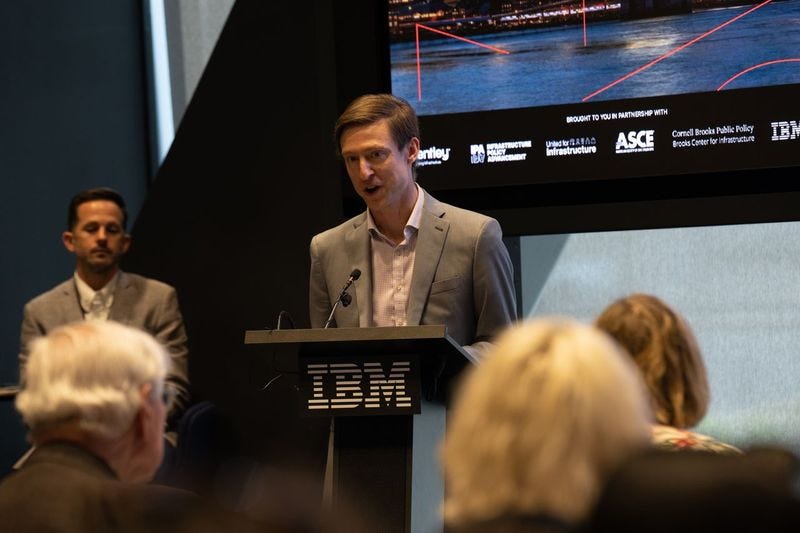
TIP NYC 2026 brought together more than 170 leaders from engineering, government, finance, and technology. I moderated a session on AI and infrastructure with Rick Geddes (Cornell), David Goldwater (Stantec), Santiago Garces (City of Boston), and Olivia Volkoff (Constellation Energy). For takeways from our session, read AI Will Not Modernize U.S. Infrastructure Without Better, Actionable Data.
Harnessing AI for Real Climate Impact — Columbia University

On April 20, I joined researchers, city practitioners, and investors at Columbia University for a panel on using AI to address climate challenges. Some concrete examples: AI-powered wildfire detection in Austin, analysis of 1.2 million UK buildings for bulk energy procurement, and community drone monitoring of illegal dumping in Baltimore. The costs are equally real, from energy and water to misleading data. One optimistic takeaway: AI that accelerates permitting and project delivery can create more work, not less.
Upcoming Events
Purpose Summit: AI for Community Resilience
🗓️ May 12, 2026 📍 Civic Hall, New York

PolicyAlpha is partnering with CIV:LAB for a convening that brings together voices from Microsoft, JPMorganChase, CoreWeave, NAACP Capital, MIT Media Lab, and more. As institutions face intertwined challenges, conversations across silos are critical to shaping a future where AI advances resilient, thriving communities. Learn more and register here.
Infrastructure Week: “Powering Growth: Grid Capacity & Data Center Demand”
🗓️ May 19, 2026 |📍 Business Roundtable, Washington D.C.

During Infrastructure Week, I’m speaking about “Powering Growth: Grid Capacity & Data Center Demand. We’ll talk about how policy, permitting, interconnection, and financing must change to deliver reliable power for AI, electrification, and manufacturing. Learn more and request an invitation to join us.
What I’ve Been Reading
Lynne Kiesling: Data Centers, Flexibility, and the Architecture of the Grid
Beyond the “buzzword du jour in electricity,” a rigorous framing of why grid modernization is fundamentally an institutional problem, not a technical one.

Freddie deBoer: We Are (Still) Living in the Long Boring
The material improvements that changed human life ran on physical infrastructure: steel, concrete, copper wire. As Freddie reminds us, not everything accelerates equally. “Code cannot insulate your house; no algorithm has ever laid a water pipe; the internet has not built a single mile of high-speed rail.”

What’s Ahead?
I’ve been digging deeper into institutional decision-making under uncertainty. Infrastructure projects often stall not because of bad technology or absent capital, but because it’s tough to make decisions when the outcomes won’t be known for years.
Have any examples of projects that went particularly well (or poorly)? I’d welcome ideas, pushback, and questions.
David Gilford is the Managing Partner of PolicyAlpha. Connect with him on LinkedIn.